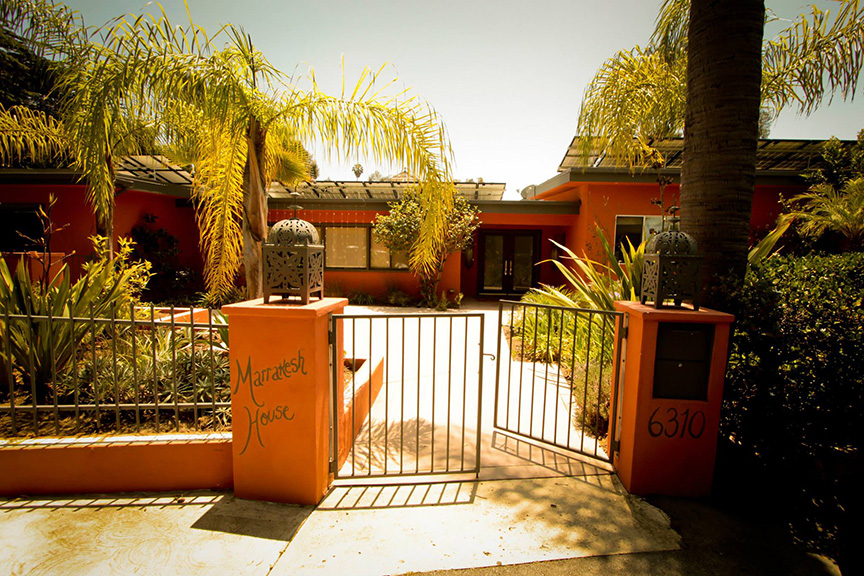
Located on a hillside adjacent to California’s newest State Park, the Baldwin Hills Scenic Overlook in Culver City, Marrakesh House is one of the most environmentally friendly remodels in Southern California. Documentary filmmaker Chris Paine, director of the acclaimed film Who Killed the Electric Car? purchased the home in 2007 with the aim to transform the original Mid 20th Century Modern home into a model for sustainable living in the 21st century. In the process, Paine has also created a private residence that doubles as venue for art, music and culture in the surrounding community.
“Bringing people together has always been important to me, especially living in Los Angeles where everything is so spread out,” says Paine. “I wanted Marrakesh House to provide a relaxed artistic atmosphere that reflects my interests in different cultures and demonstrates eco-friendlier living to anyone who visits. I hope Marrakesh House proves that greener living can be artistic and fun.”
Paine traveled to Morocco in 2008 and discovered that the layouts of traditional Moroccan “riads” center on a courtyard, in a way that mirrors the layout of his new property. With Marrakesh and Los Angeles located on similar latitudes, each with desert topographies near high mountains, he decided to call his remodel “Marrakesh House” combining the home’s Mid-Century modern architecture with Islamic design motifs to forge a visual bridge between two cultures.
Paine rarely wavered in his commitment to remodel the 4,300 square-foot house using environmentally friendly guidelines. He assembled a team of dedicated craftspeople, led by project manager, noted LEED AP, Shellie Collier. He also brought on board sponsors who were passionate about a reconstruction that would showcase greener living. When asked about their choices in planning the remodel, Shellie said, “I’m very glad we spent time considering how to take advantage of what the house already had instead of tearing everything down. Sometimes the future is about simply remaking the present.”
The team succeeded in making most changes to the house in accordance with the motto ‘reduce/reuse/recycle’. According to Collier, this motto means “using as much existing material as possible in order to significantly lower the carbon footprint during the remodeling process.” Paine ensured that measures were taken to harness the renewable, sustainable energy of the bright Southern California sun by installing roof panels to generate solar power for both plug-in electric vehicles and the residence itself.

‘Reduce/Reuse/Recycle’ in Practice
During reconstruction, the Marrakesh House team realized the ‘reduce/reuse/recycle’ theme by reusing lumber and soil from the original house, repurposing cement, and rebuilding the old kitchen cabinets into new bathroom cabinets. Materials that could not be used were sent to specialized reclamation. In the end, the Marrakesh House team managed to divert much of the construction debris from 1950s-1970s era construction from landfill into reuse.
Careful material selection during the remodel process allowed the house to evolve into a healthier, more environmentally conscious place to live. Formaldehyde-free construction materials, including insulation, drywall paper, cabinets and veneer, were employed wherever possible, which improved indoor air quality.
In building areas where new lumber was needed, the team chose wood that was Forest Stewardship Council (FSC) certified. “We’ve talked to many sources,” said Collier, “and FSC lumber is really worth the small amount extra you pay.” The team chose reclaimed barn wood for some projects as well as reused concrete from construction sites around the city for the retaining walls. For the floors, stone was selected because it endures hundreds of years and eventually decomposes into the earth.

With Southern California’s desert topography and drought conditions in mind, plumbing co-sponsor Toto-USA donated dual-flush toilets and low-flow faucets including a model that automatically shuts off after use for all bathrooms. Toto-USA showroom coordinator and interior designer Allan Dallatorre served as the bathroom design product specifier, working to make all the baths more sustainable. Dallatorre notes, “The Marrakesh show house contains some of the most water efficient fixtures that TOTO has to offer. Such as: HEF – High Efficiency Faucets, HES – High Efficiency Showers and HET – High Efficiency Toilets.” Pittsburgh Paint donated VOC-free (volatile organic compound free) paint for much of the entire floor plan. All of these decisions reduced the total carbon footprint of the house.
One artistic showcase of ‘reduce/reuse/recycle’ is in the remodeling of the courtyard. Rather than replacing permanently water-stained double paned patio windows with new glass, Paine secured Burning Man/Coachella Music Festival artist Shrine to paint the original glass in a Moroccan style and incorporate the existing watermarks into the design. The original beams that frame the central courtyard were carefully restored by local craftsmen to create an architectural space that brings the Moroccan “riad” feeling to life.
Energy
One of the most inspiring features of the house is its use of solar energy. The solar energy is generated by a sleek 6.66kW DC solar electric system on the roof that is comprised of 36 Mitsubishi Electric-sponsored panels that use 100% lead-free solder and produce an estimated 11,000 kWh of clean electricity every year. The photovoltaic panels, installed by co-sponsor REC Solar, who also sponsored chargers for the electric vehicle and plug-in hybrids, power the house and garage. Any excess solar electricity the system produces feeds directly back into the grid. Inside the house, educational kiosks set up by Mitsibushi Electric and REC Solar teach visitors about solar energy by displaying real-time data about the sun’s energy collected on the roof.
“We are excited to support a project that combines solar energy, energy efficiency and sustainable construction, and we are proud to know our modules are helping pave the way for electric transportation,” said Gina Heng the director of sales and marketing for Mitsubishi Electric’s photovoltaic division.
“REC Solar is excited to contribute in educating the public about solar energy through the Marrakesh house project,” said Isabelle Christensen, Senior Director of Marketing and Public Relations at REC Solar. “We will be holding solar seminars for small groups at the Marrakesh house in the coming months. In addition, we can also show how the solar system is performing with online solar monitoring software.”

The solar electric generating system is complemented by the home’s high energy- efficiency. As lighting often accounts for up to 25% of a homes’ electricity use, it is important to reduce this load to reduce the number of panels needed for the photovoltaic (PV) solar electric generating system. Consequently, the lighting here uses some of the most recent innovative light bulb technologies: non-dimmable compact fluorescent (CFL), dimmable cold cathode (CCFL), and dimmable solid-state, light emitting diodes (LEDs).
“As electricity-saving goes, energy-efficient lighting represents enormous potential to reduce the production of climate changing carbon emissions. So, the better it looks and works, the faster it will be embraced by the public,” says Chris Myers, Principal of enLIGHTen, the energy-efficient lighting design firm.
Inside, state-of-the-art, warm, dimmable LED striplights grace the kitchen cabinets, using 50% less than typical fluorescents and 92% less than xenon or halogen tasklights. In the Moroccan Room, 5-watt “cold cathode” screw-in lamp technology in the sconces provides sensual ambiance with lamps that use over 85% less electricity and that last an astonishing 25,000-hours or 25x longer than a normal 40-watt bulbs.
Outside, nighttime visitors are greeted at the entrance by the broad canopy of the grand-father palm illuminated with only 15-watts of LED lamps that will perform their inviting magic every night for the next 13 years before they burn out. And the entire 1,000-square-foot courtyard landscape is dramatically illuminated using only (10) 3-watt LED lamps that allow a savings of 94% of the electricity.
Lighting controls also increase the savings and energy-efficiency. As the most efficient and least polluting light bulb is a light that is off, user-friendly motion sensor switches turn off some closet lights when not needed, and a motion sensor turns the powder room fan off when its job is done. Selected dimmers throughout also allow greater control of ambiance while reducing energy use, and like surge-protectors on computers, the dimmers help protect the lamps (light bulbs) so they last longer, meaning fewer bulbs in the landfill and fewer trips to the store for more.

On the south side of the roof, another two-panel solar thermal array uses the sun to heat water for two full bathrooms and one half bath. The water is stored in a 97% efficient stainless steel water tank. On-demand tankless water heaters supplement the thermal array.
Electric Vehicles
As a residence for the director of Who Killed the Electric Car? no garage would be complete without solar powered plug-in electric vehicles. During the remodeling, three 220volt chargers were installed to charge on-site and visiting plug-in vehicles, whether electric scooters or plug-in hybrid conversions. “Of course, you can plug almost any electric car directly into a regular wall socket – it just takes longer that way,” notes Paine. At the moment, Paine’s “plug-in mecca” includes a 2002 Toyota Rav4-EV and his 2008 Tesla Electric Roadster, both of which have cameos in his upcoming film Revenge of the Electric Car. “Electric Cars make powering your car with renewable energy off your house easy. You just can’t do that with a gas car.”

Garden/Landscaping
The project’s commitment to ‘reduce/reuse/recycle’ continued beyond material selection and construction. Landscaper Clayton Winans and his team removed one of the two pre-existing lawns and transformed it into a side-yard catering area. They created outdoor flooring by choosing permeable decomposed granite over concrete.
Resolved to retain as many existing plants as possible in the remaining yard, Winans only introduced new flora that required minimal or no irrigation and selected as many native species as possible. To conserve water, high-efficiency nozzles and drip irrigation systems were installed across the grounds. Six area zones are timed specifically to conserve water.

The organic garden is a year-round “Victory Garden” designed by Christy Wilhelmi of co-sponsor Gardenerd www.gardenerd.com. “Having an organic garden in an urban environment means we’re less reliant on non-organic foods trucked into our cities. It supports both neighborhood and environment, just like the ‘victory gardens’ during World War II.” Wilhelmi created planter boxes made out of Trex Decking – a recycled material – and designed three seasons of crops to take advantage of Los Angeles’s climate and low-water irrigation. The yard also features shade and fruit trees selected by arborist John Lyons including mandarin, plum, apricot, avocado and lemon, to complement the garden.
The property’s eucalyptus trees were pruned to reduce fire hazards, and the larger branches were then repurposed as fencing around the property. A neighbor offered cuttings from his giant cactus plants for the property’s western front, and original hedge areas were restored with a mix of species to increase plant diversity.
Arts and Culture
The filmmaker in Paine wanted to create a residence that incorporated the arts into a living environment. For special events, the team designed performance spaces in both indoor and outdoor areas. They worked to make acoustic performances and A/V presentations reach as many guests as possible without disturbing neighbors. Sliding and folding glass doors connect interior and exteriors of the house and several walls become screens for film or other projections.
“One of our goals was to let artists, activists and musicians from around the world share their work in an intimate space. One nice thing about Marrakesh House is that we are in a location central to Los Angeles and next to a State Park with a lot of open space,” says Paine.

Of the many designers involved with the remodel, two created signature pieces for Marrakesh House. Interior designer Charlotte Jackson transformed a bedroom at the back of the house into the sublime “Marrakesh Room.” And Los Angeles artist Shrine, who fabricated the spectacular temple at Burning Man (2008) and the ‘Lucent Dossier’ stages at Coachella (2009), installed his latest work “Lemon Tree Teahouse” (2009) on the far side of the pool. Shrine also painted the house’s 1960s water damaged double paned windows glass to make Moroccan windows.

In all Paine has created an artistic space and a home that brings Mid-Century modern into the 21st century with a popular, current, and eternal style with a focus on sustainability that will never go out of fashion.
# # #
For more information on Marrakesh House please see http://marrakeshhouse.com or
contact Susan von Seggern susan@susanvonseggern.com or 213-840-0077.